Optimize within the asset envelope
Evaluate schedules using power and energy limits, efficiency assumptions and configurable state-of-charge boundaries.

Connect battery storage, renewables and site demand. Turn operational data, market signals and asset constraints into coordinated energy decisions.
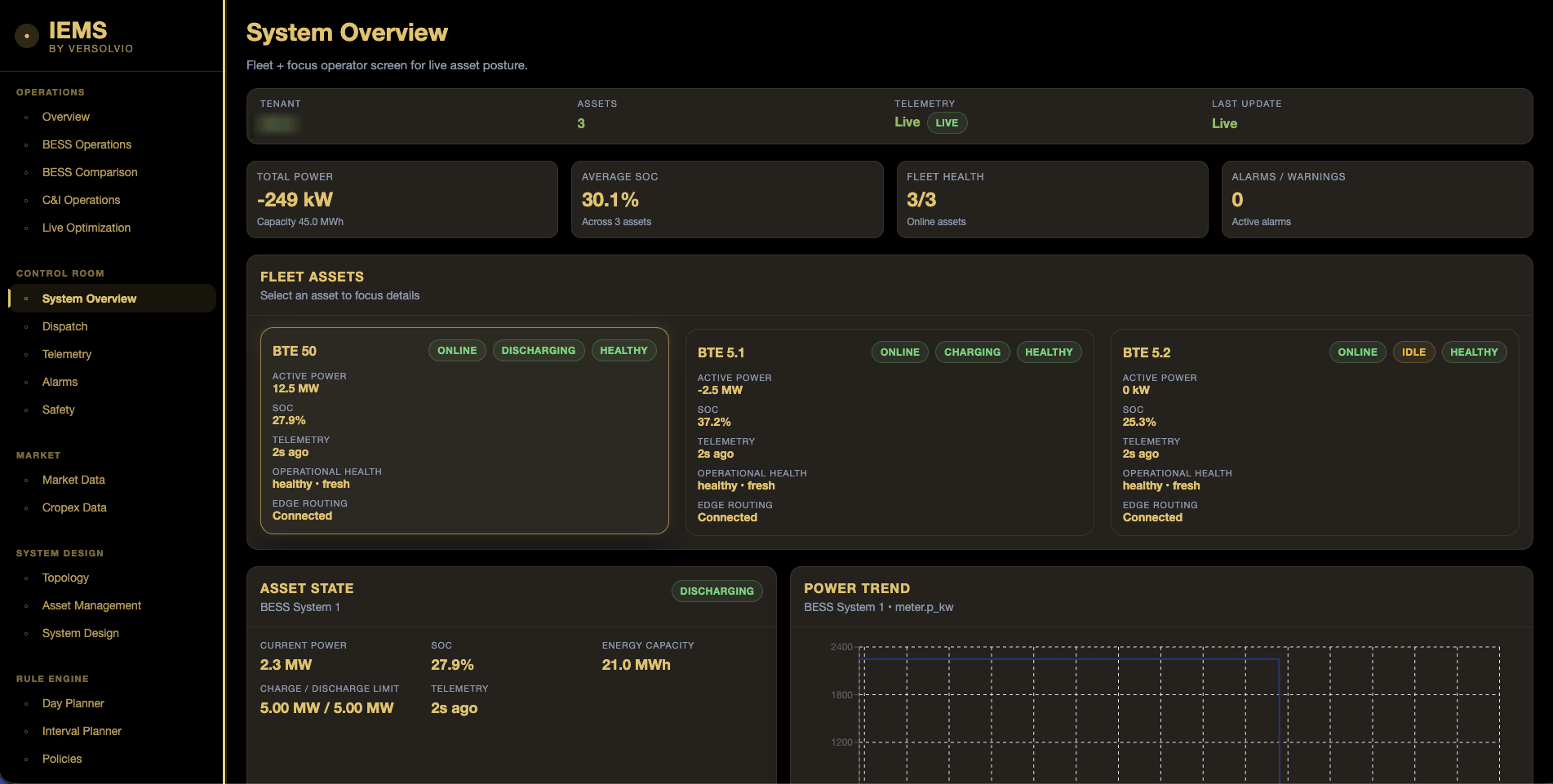
Live asset status, state of charge, power and telemetry freshness in a focused operator workspace.
View full screen ↗Actual interface screenshots supplied by Versolvio. Values and runtime states represent the captured environment; financial examples are not performance forecasts.
ONE OPERATIONAL ENVIRONMENT
IEMS brings the operational and commercial sides of energy together. Operators work with a shared asset model, while planning, dispatch and automation coordinate around site limits and battery constraints.
OPTIMIZATION WITH CONTEXT
A battery has finite energy, power limits and competing priorities. IEMS connects market opportunities with site demand and operating constraints to evaluate how that flexibility can be used.
Evaluate schedules using power and energy limits, efficiency assumptions and configurable state-of-charge boundaries.
Compare baseline and optimized grid power alongside battery impact, price signals and reserve requirements.
Separate optimization proposals from dispatch constraints and execution. Monitoring and verification keep operating feedback visible.
The supplied interface demonstrates reserve envelopes, upward and downward activation scenarios and ancillary-service value analysis. Live aFRR participation depends on the contracted integration, validation and applicable market qualification.
BUILT AS A CONNECTED SYSTEM
A Next.js operator interface connects to Go microservices. Routing, dispatch decisions, workflow orchestration and automation have distinct responsibilities, supported by shared telemetry and market data.
Logical architecture overview. API requests are routed to the responsible services; events and telemetry connect workflows with site feedback. Physical topology and enabled modules are defined per project.
DEPLOYMENT & INTEGRATION
Select the deployment around operational autonomy, IT/OT boundaries, connectivity and integration requirements.
A hosted environment for central visibility, data analysis and coordinated portfolio access.
Project-specific local deployment for selected control services and integration with site infrastructure.
Combine local control with cloud visibility. Local safety interlocks remain part of the site design.
BMS, PCS, inverter, meter and SCADA interfaces are engineered per project. Protocol scope can include Modbus, OPC UA, IEC 61850 and REST APIs.
COMMERCIAL FLEXIBILITY
Deployment, asset scope, enabled modules, integrations and service requirements define the commercial agreement. Licensing and support terms are agreed for each project.
Discuss a hosted software agreement aligned with the required platform and service scope.
Define the right-to-use scope for a specified installation and operating environment.
Structure a partner agreement for integration into a wider energy solution or project portfolio.
These are engagement routes, not fixed product tiers. License duration, fees, hosting, integration, maintenance and SLA commitments are confirmed in the project offer.
Request a tailored proposal ↗QUESTIONS, ANSWERED
Standalone BESS, PV + BESS and wind + BESS configurations, as well as controllable demand and grid connections. Supported devices and functions are confirmed through the integration scope.
Integration is scoped around the existing SCADA, supported interfaces and responsibility boundaries. Protocol selection, control permissions and verification requirements form part of engineering.
No. They show the captured scenario and its assumptions. Actual results depend on asset performance, operating constraints, market prices, activation and the contracted operating model.
Role-based access, audit logging, secure interfaces and OT/IT separation are addressed in the deployment design. Local safety interlocks and the required level of offline autonomy are defined and validated for each site.
Share your asset configuration, site limits, intended operating modes, integration interfaces and deployment requirements. We can then define the technical scope, commissioning approach and commercial proposal.
YOUR ASSET. YOUR OPERATING PRIORITIES.